Picture the vowel space not as a grid of labelled boxes but as terrain. Every point is a vowel you could produce — F₂ running across, from front to back; F₁ down the side, from close to open. A continuous plane, with no borders drawn in advance.
Now give the terrain height. Two forces are enough. The first is perceptual: there is a target — a place where the vowel ought to sound — and drifting away from it is costly. The second is articulatory: speaking takes effort, and effort is measured as distance from the tongue's rest, that slack position it holds before speech. Add the two, each with its weight, and the ground takes on relief:
$$H(F_1,F_2)=p_P\,v_P + p_A\,v_A$$
Where the ground is low there is harmony; where it rises, violations pile up. The idea that a grammar is forever bargaining between being easy to say and easy to hear is an old one (Boersma, 1998; Flemming, 2001).
And here the intuition turns pretty: the winning candidate isn't picked off a list. It rolls. Drop a vowel anywhere on the map and let it run down the gradient, downhill, until there's nowhere lower to go:
Where it stops is a bargain. The floor of the valley — the optimum — always falls somewhere on the line joining rest to target, and its exact spot is a weighted average of the two:
$$x^\ast=\frac{p_P\,T + p_A\,N}{p_P + p_A}$$
Turn up the perceptual weight and the winner hugs the target; let effort have its way and it slides back toward rest. Which is no different from what a tableau would tell us, if we built one from a handful of vowels and the same two constraints. With perception pulling harder, the one nearest the target wins:
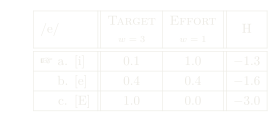
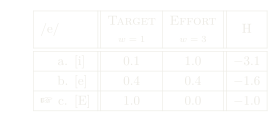
Flip the weights, let effort dominate, and the winner retreats to the resting vowel (the middle one, [e], sits halfway along):
If you'd sooner check the sum than trust the relief, the optimum is just that weighted average — and a gradient descent lands right on it:
# The F1xF2 space, two weights, and the same harmony landscape as the figure.
# The optimum is the weighted average of target and rest; gradient descent lands on it.
F1 = (280, 760); F2 = (1350, 2450)
T = (350, 2200); N = (610, 1900)               # perceptual target, tongue's rest
nu = lambda f2: (f2 - F2[0]) / (F2[1] - F2[0])
nv = lambda f1: (f1 - F1[0]) / (F1[1] - F1[0])
Tn = (nu(T[1]), nv(T[0])); Nn = (nu(N[1]), nv(N[0]))
back = lambda u, v: (round(F1[0] + v * (F1[1] - F1[0])), round(F2[0] + u * (F2[1] - F2[0])))

def optimum(pP, pA):
    s = pP + pA
    return back((pP * Tn[0] + pA * Nn[0]) / s, (pP * Tn[1] + pA * Nn[1]) / s)

def descend(pP, pA, eta=0.14, steps=300):
    u = v = 0.05                               # start high, a close front vowel
    for _ in range(steps):
        u -= eta * (pP * (u - Tn[0]) + pA * (u - Nn[0]))
        v -= eta * (pP * (v - Tn[1]) + pA * (v - Nn[1]))
    return back(u, v)

for pP, pA in [(3, 1), (1, 1), (1, 3)]:
    o = optimum(pP, pA); d = descend(pP, pA)
    print(f"pP={pP} pA={pA}  optimum F1={o[0]} F2={o[1]} Hz   descent -> F1={d[0]} F2={d[1]}")
In the end nobody had to discretise anything first. The categories weren't placed on the map; they are the valleys of the map, the places where the ground caves in. Doing phonology, here, is only looking for the lowest ground — and letting the vowel roll down to it (Prince & Smolensky, 2002). That the ground can live in a continuous space, rather than a list of boxes, is a liberty weighted grammars already know how to take (Lefkowitz, 2017).
- Boersma, P. P. G. (1998). Functional Phonology: Formalizing the Interactions between Articulatory and Perceptual Drives.
- Flemming, E. (2001). Scalar and categorical phenomena in a unified model of phonetics and phonology. Phonology.
- Prince, A., & Smolensky, P. (2002). Optimality Theory: Constraint Interaction in Generative Grammar.
- Lefkowitz, L. M. (2017). Maxent Harmonic Grammars and Phonetic Duration.
Barroso, A. M. (2025). The vowel space as a landscape. alexandrebarroso.com. https://alexandrebarroso.com/notes/the-vowel-space-as-a-landscape.html
@misc{barroso2025thevowelspaceasalandscape,
  author       = {Alexandre Menezes Barroso},
  title        = {The vowel space as a landscape},
  year         = {2025},
  howpublished = {alexandrebarroso.com},
  url          = {https://alexandrebarroso.com/notes/the-vowel-space-as-a-landscape.html},
  note         = {alexandrebarroso.com}
}