Why does a vowel "reduce"? The question sounds as if there were a switch — in a certain position the rule fires and [e] turns into [ə]. But it may be more honest to think of a balance, not a decree.
Two forces pull at every vowel. On one side, effort: speaking is tiring, and the mouth prefers its rest, that slack centre near schwa. Pulled by it alone, every vowel would slide to the middle. On the other, contrast: a vowel is only good for anything if it stays distinct from its neighbours — if [i], [e] and [ɛ] collapsed onto a single point, a listener would have no way to tell them apart. That force shoves them away from each other, out toward the edges of the space.
$$E=\underbrace{\alpha\sum_i x_i^2}_{\text{effort}}+\underbrace{(1-\alpha)\sum_{i\lt j}\frac{1}{|x_i-x_j|}}_{\text{contrast}}$$
The inventory we actually observe is the truce between the two. Work the balance and watch: when contrast has the upper hand, the vowels open up and take the periphery; when effort does, they crowd toward the centre:
Notice what doesn't happen: there's no magic threshold where "reduction" switches on. The inventory's width eases down as effort weighs more — following, as it happens, a little cube-root law. Reducing, on this reading, isn't a rule that fires in an unstressed syllable; it's just what's left when keeping the vowels apart costs more than it's worth (Flemming, 2004; Flemming, 2005). The same tension between economy and distinctness has been brought to bear on reduction in pretonic position (Kenstowicz & Sandalo, 2016).
If we'd rather speak in tableaux, we just let whole inventories compete, each weighed by the same two constraints. With contrast weighing more, the spread-out system wins:
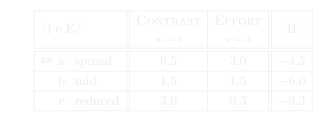
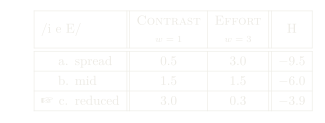
Flip the weights, let effort dominate, and the winner is the shrunken inventory, all pushed toward the centre (the middle ground goes to the in-between system):
And if the sum is worth more to you than the picture, you can watch the equilibrium width slide down smoothly as effort grows — with no jump anywhere:
# Five vowels on a perceptual axis. Effort pulls to the centre; contrast splits them apart.
# We minimise the energy and measure the inventory's width for several weights.
N, K, EPS = 5, 0.04, 0.03

def width(alpha, steps=4000, eta=0.003):
    x = [-0.7 + 1.4 * i / (N - 1) for i in range(N)]
    for _ in range(steps):
        g = []
        for i in range(N):
            gi = 2 * alpha * x[i]                          # effort: pulls to the centre
            for j in range(N):
                if j != i:
                    d = x[i] - x[j]; ad = abs(d) + EPS
                    gi -= (1 - alpha) * K * (1 if d >= 0 else -1) / (ad * ad)  # contrast
            g.append(gi)
        for i in range(N):
            x[i] -= eta * g[i]
    x.sort()
    return x[-1] - x[0]

print("effort α     width      ~((1-α)/α)^(1/3)")
for a in [0.1, 0.3, 0.5, 0.7, 0.9]:
    w = width(a)
    print(f"   {a:.1f}       {w:.3f}        {((1 - a) / a) ** (1 / 3):.3f}")
In the end no category is erased by decree. They are squeezed out when the price of keeping them distinct climbs too high — and, in a continuous space, that price isn't a switch you flip but a dial you turn (Lefkowitz, 2017).
- Flemming, E. (2004). Contrast and Perceptual Distinctiveness. Preprint.
- Flemming, E. (2005). A Phonetically-Based Model of Phonological Vowel Reduction.
- Kenstowicz, M., & Sandalo, F. (2016). Pretonic Vowel Reduction in Brazilian Portuguese: Harmony and Dispersion. Journal of Portuguese Linguistics.
- Lefkowitz, L. M. (2017). Maxent Harmonic Grammars and Phonetic Duration.
Barroso, A. M. (2025). Effort vs. contrast: why vowels reduce. alexandrebarroso.com. https://alexandrebarroso.com/notes/why-vowels-reduce.html
@misc{barroso2025whyvowelsreduce,
  author       = {Alexandre Menezes Barroso},
  title        = {Effort vs. contrast: why vowels reduce},
  year         = {2025},
  howpublished = {alexandrebarroso.com},
  url          = {https://alexandrebarroso.com/notes/why-vowels-reduce.html},
  note         = {alexandrebarroso.com}
}